Who is your customer?
- Ninad Patil
- Business , Negotiation
- March 11, 2024
Who is your customer?
What comes to your mind when you think of your customers
- they are the most important part of your business ecosystem
- you do everything to service their needs and keep them happy
- you wish to maintain good relationships with them and
- at times go out of your way to sustain relationships and retain them in your value chain
One of the key elements that keeps us focused on the customer satisfaction journey is constantly monitoring, managing and fulfilling their “expectations”. And “expectations” is the key word which will help us expand this discussion.
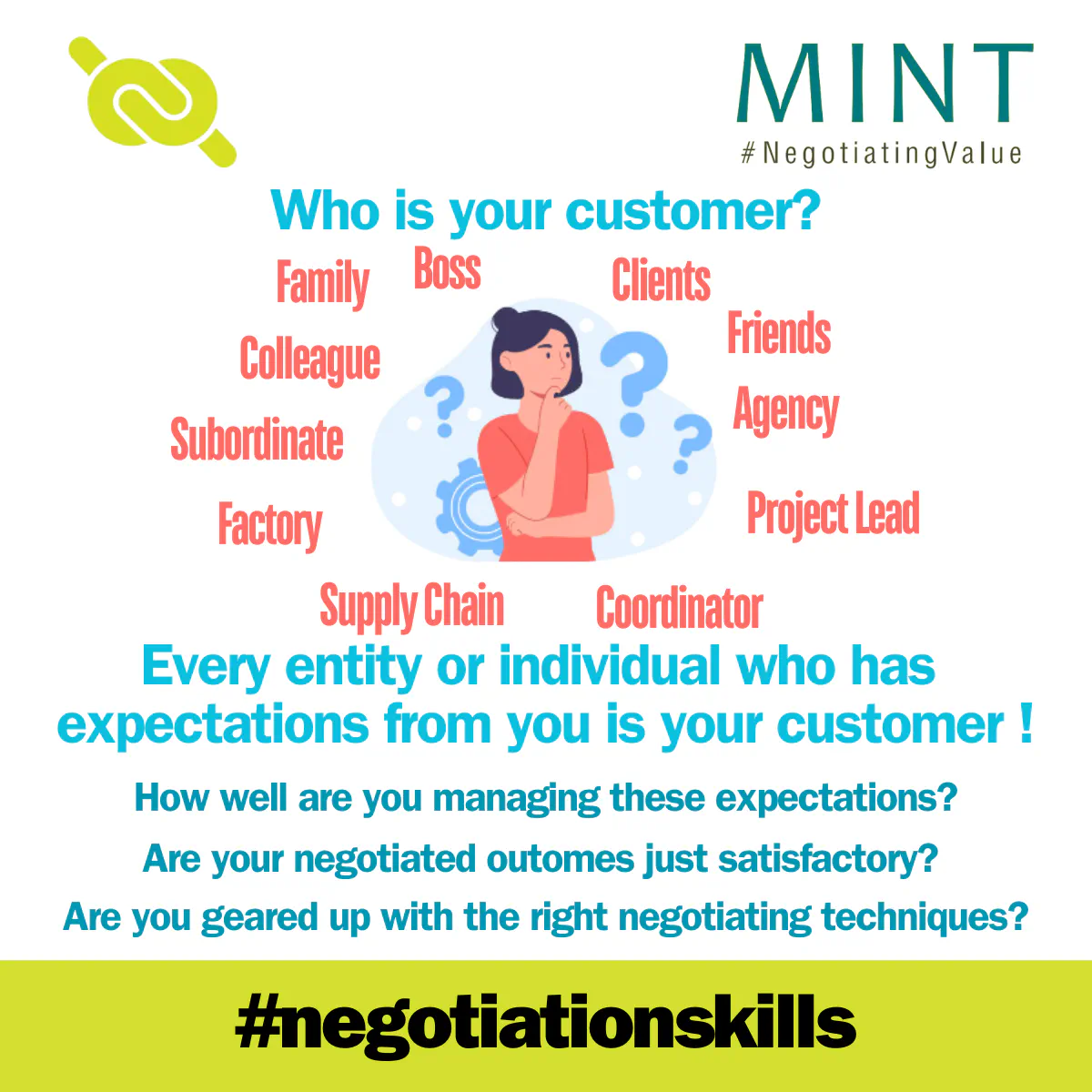
To reiterate monitoring, managing and fulfilling “expectations” is the key element which defines what we constantly do for our customers. Now when we zoom out into our professional and personal ecosystem we realize that every individual or entity visible through the lens has some or the other expectation from us. We are constantly working to manage expectations of your family, friends, managers, suppliers, colleagues, subordinates and almost everyone around. So does that make all of them our customers - a big YES.
With this discussion let’s introduce a thought that if we consider every entity and individual as our customer the possibility to sustain relationships, fulfill expectations and create mutual value is very high. Isn’t that an immense responsibility to carry? And to a large extent we are successfully managing most of these responsibilities.
The real challenge however is to get back in return what we expect from them. The other challenge is to negotiate on these expectations with the stakeholders and ensure that the outcomes are mutually beneficial. The strains in relationships (personal and professional) actually start when expectations are not well communicated and negotiated.
The M I N T Negotiating Programs address these specific challenges in your “expectation” management journey. Connect with us to get deeper insights and how we can together build a customer centric enterprise.