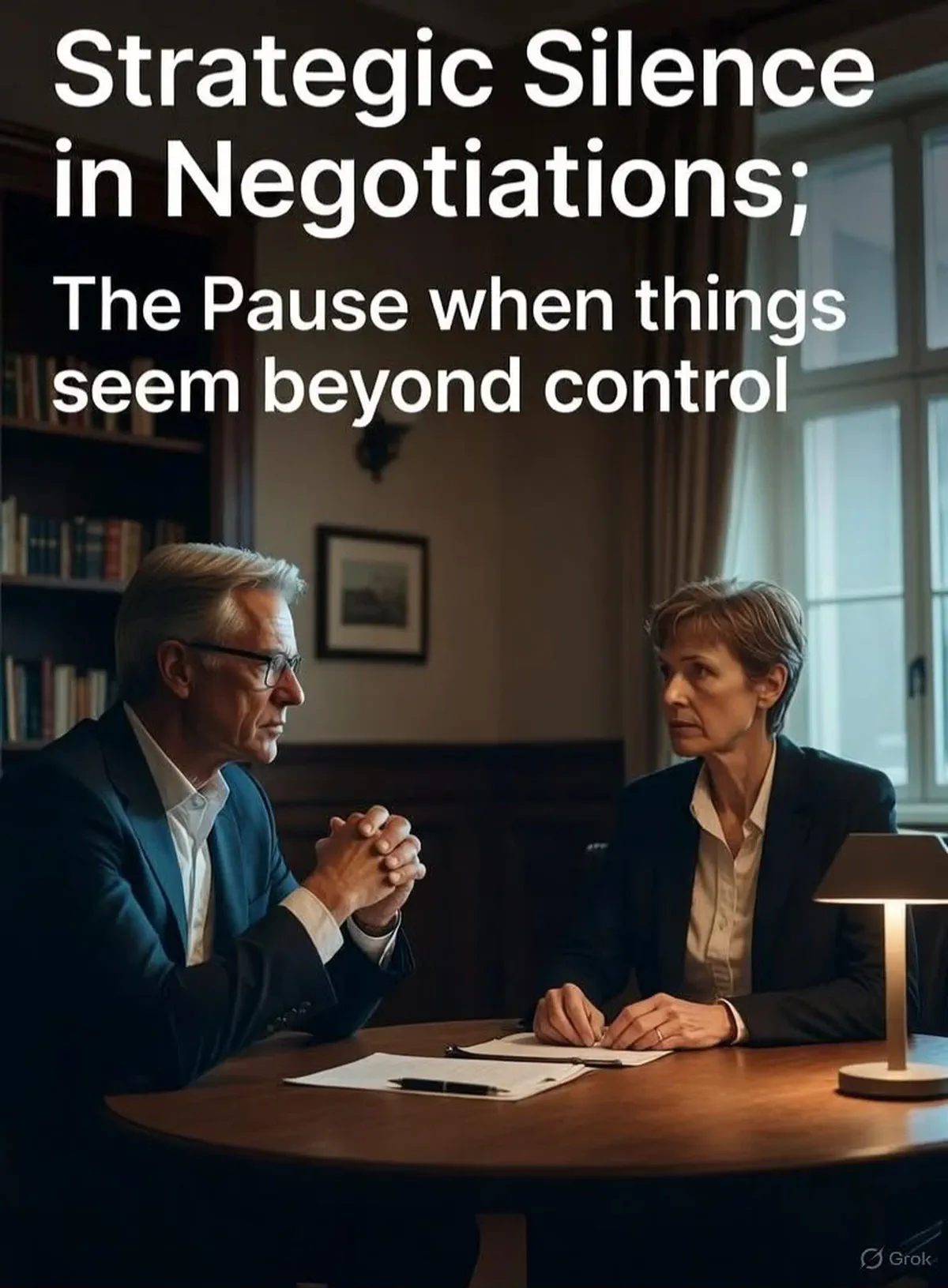
Strategic Silence in Negotiations: The Pause When Things Seem Beyond Control
- Ninad Patil
- Business , Negotiation
- September 24, 2026
Table of Contents
There are moments in every high-stakes negotiation when the conversation stalls. The last offer sits on the table. The room goes quiet. Everyone looks at everyone else — and the pressure mounts to fill that silence with anything — a concession, a justification, a distraction.
The person who speaks first after that pause loses ground. Every time.
Strategic silence is not the absence of action. It is one of the most direct forms of pressure in a negotiation. In my two-and-a-half decades of live deal work — at Tata Steel, in boardrooms across Mumbai and Delhi, and now with enterprise teams — I have seen silence win deals that words could not close.
The pause is not empty space. It is the moment the other side decides whether to reveal their true position or protect it by conceding.
Why Silence Works When Nothing Else Does
When a counterpart hears silence after an offer, proposal, or counterargument, their brain registers uncertainty. They cannot read your reaction. They do not know if you are considering walking away, evaluating an alternative, or simply satisfied with the last exchange. That ambiguity is uncomfortable — and discomfort drives behavior.
The other person will often fill that void themselves. And in doing so, they reveal information they would never have shared through a direct ask.
This is the mechanism behind effective silence:
- The power shifts to whoever can tolerate the tension longer — not whoever speaks more
- Information flows from discomfort — the party who talks first usually talks into a concession
- Silence signals conviction — a negotiator who waits says, without words, “I am comfortable here. Move or stay.”
Think of it this way: every time you break a silence that is actually working in your favor, you are volunteering information — often the very thing the other side is waiting for before they push back hard.
How to Deploy Silence as a Weapon
Silence is only strategic when it is intentional. Random pauses create confusion; deliberate ones create leverage. Here is how professional negotiators use them.
After Delivery — Let Your Anchor Settle
In our previous posts on anchoring, we covered how the first number shapes the entire negotiation and how to anchor across multiple dimensions simultaneously. Once you land your anchor — any anchor — do not immediately justify it. Do not add qualifiers. Do not soften it with context that was never asked for.
Simply state your position and wait.
That pause communicates absolute belief in what you just said. The other side must now respond to your number on its own terms, while you hold the frame you just built. A single sentence left ringing is more forceful than three paragraphs of explanation.
After an Offer — Force Them to Justify Again
Your counterpart makes their best offer. It may sound reasonable in the moment. Instead of immediately engaging with the substance, pause for four or five seconds. Make eye contact. Then ask a calm, narrow question: “Help me understand how you arrived at that figure.”
This does two things simultaneously: it signals that the number needs defending (even though they just offered it), and it puts the onus on them to generate arguments for their own position. In practice, once a party has already committed to a number, being asked to justify it again makes them second-guess it — which softens their resistance to your counter.
During Deadlock — Change the Temperature in the Room
When a negotiation enters stalemate territory — both sides firmly planted on opposing positions — speaking more usually entrenches things further. At that point, strategic silence acts as a reset button because it breaks the rhythm of escalation.
I have seen executives who had just argued for ten minutes lose their footing entirely once I stopped talking and looked at them for four seconds. The person across from me would often say something like “Look, let’s be practical about what we can actually deliver here” — which is effectively a reopening of the position they claimed was fixed moments earlier.
Tip
Silence works best when it feels deliberate and confident — not awkward or reactive. Maintain steady eye contact, keep your posture relaxed, and time your pause to last at least three full seconds. Anything shorter registers as hesitation; anything that long reads as a calculated move.
What Silence Actually Does in Real Negotiations
The effect of silence is measurable if you know what to watch for. In my own experience leading procurement negotiations, sales team training, and enterprise coaching, I have tracked these specific outcomes:
- Premature concessions: The opposing side will offer something extra or soften a number simply to break the quiet — even when they had no intention of moving
- Over-explanation: The other party justifies and rationalizes their last position more than necessary, and in doing so exposes assumptions you can later challenge
- Increased receptiveness: A pause immediately before you deliver new information makes whatever you say next land with greater weight — because the room has been quiet long enough for attention to refocus completely on you
This is active leverage. It requires nothing but nerve to execute, yet most negotiators — including ones who have sat across from me dozens of times instinctively betray it every time they reach for a word instead of holding position.
The Risk: Knowing When Silence Stops Working
Silence is powerful precisely because it is uncomfortable. Used correctly it bends the other party’s position toward yours, used incorrectly it makes you seem disengaged or evasive rather than assertive and measured.
Watch for these signals that indicate you should break the silence now:
They stop trying to fill it. Your counterpart has sat quietly alongside you for an extended period without conceding anything — they are either equally comfortable or genuinely have nothing more to give. Continue longer and you risk a dead-end where both sides disengage entirely.
Your goal is understanding, not pressure. When the objective of the conversation is discovery rather than influence — early relationship building or needs assessment — excessive silence reads as hostility instead of strategy. In those contexts, measured questioning outperforms deliberate stillness.
The other side signals a genuine constraint. Hard data, policy limits, external approvals — these are positions that cannot be moved by pressure alone and silence only creates resentment when the person across from you is telling the truth about their boundaries.
Pairing Silence With Anchoring for Maximum Impact
The two techniques reinforce each other far more when used together than either does alone. Here is the sequence that consistently works in client procurement negotiations I have structured:
- You anchor across multiple dimensions — service levels, delivery timelines, penalties (as discussed in our multi-dimensional anchoring post)
- You state your opening position clearly and stop talking
- Silence forces the other side to engage with every dimension you just introduced rather than collapsing back to price alone
- When they respond, you pause again before answering — making them feel that response is being weighed carefully against all parameters simultaneously
The cumulative effect is a negotiation where the architecture you laid out feels immovable because you never seemed eager to defend it or rush to justify it. That confidence — communicated entirely through pauses and restraint — makes even aggressive anchors look reasonable by comparison.
Making Silence Part of Your Core Technique
Strategic silence does not require preparation the way research, BATNA mapping, or stakeholder analysis do. It requires something harder: discipline. The ability to sit in tension without defaulting to movement because you have internalized that your next move is more valuable than your next word.
This is why it is such a critical skill for corporate negotiators who regularly face counterparties accustomed to driving pace and setting tempo. When your teams learn to control silence they gain a lever that works regardless of the subject matter, the industry context, or the relative power balance in the room.
Our MINT Negotiation Programs train this exact capability through structured role-play scenarios where participants practice deploying silence under real pressure — because knowing the theory and surviving the actual discomfort of pausing when everything else says “say something” are entirely different experiences at the table.
You might also find useful
- Anchoring in Negotiation: How the First Number Wins the Deal — The mechanics of anchoring and why the first number sets invisible boundaries
- Anchoring Beyond Price: Negotiate the Deal, Not Just the Number — Multi-dimensional anchoring across service levels, innovation commitments, and risk allocation
- Negotiating in the Age of AI: Why Human Intelligence Still Wins at the Table — Why emotional intelligence and controlled silence outperform algorithmic responses
- Negotiation Skills Training in Mumbai — Structured workshop for sales, procurement and leadership teams across Mumbai
Book a Free Consultation → | Read more strategies on the blog →